How to Become a Pharmacist in Qatar (2026 Guide) | DHP Requirements
Becoming a pharmacist in the State of Qatar is a highly regulated and prestigious career path. Following the latest 2026 updates from the Department of Healthcare Professions (DHP) under the Ministry of Public Health (MoPH), the licensing process has been streamlined to ensure the highest standards of patient safety and pharmaceutical care.
This guide provides a detailed, step-by-step walkthrough for both local and international pharmacy graduates looking to practice in Qatar.
1. Educational Qualifications
The foundation of your application is your educational background. To be eligible for registration in Qatar, you must hold a degree from a recognized institution.
- Primary Degree: A Bachelor of Science in Pharmacy (BPharm) or a Doctor of Pharmacy (PharmD) from a university listed in the World Directory of Medical Schools or recognized by the Ministry of Education in your home country.
- Duration: The degree must be a minimum of 4 to 5 years of full-time academic study.
- Local Graduates: Students graduating from the College of Pharmacy at Qatar University follow a direct pathway and are currently exempt from certain experience and examination requirements under specific MoPH policies.
2. Professional Experience Requirements
According to Circular, issued by the DHP, experience requirements are categorized as follows:
- Graduates of Qatar-based Universities: These graduates are exempt from post-qualification work experience requirements.
- International Graduates (Outside Qatar):
- Qatari Nationals & Offspring of Qatari Women: Exempt from experience requirements.
- Non-Qataris: Generally require a minimum of one (1) year of licensed work experience in a clinical or community pharmacy setting after graduation.
- Clinical Pharmacist Title: Requires a postgraduate degree (PharmD or Master’s in Clinical Pharmacy) and typically 5 years of experience for certain higher-level designations or exam exemptions.
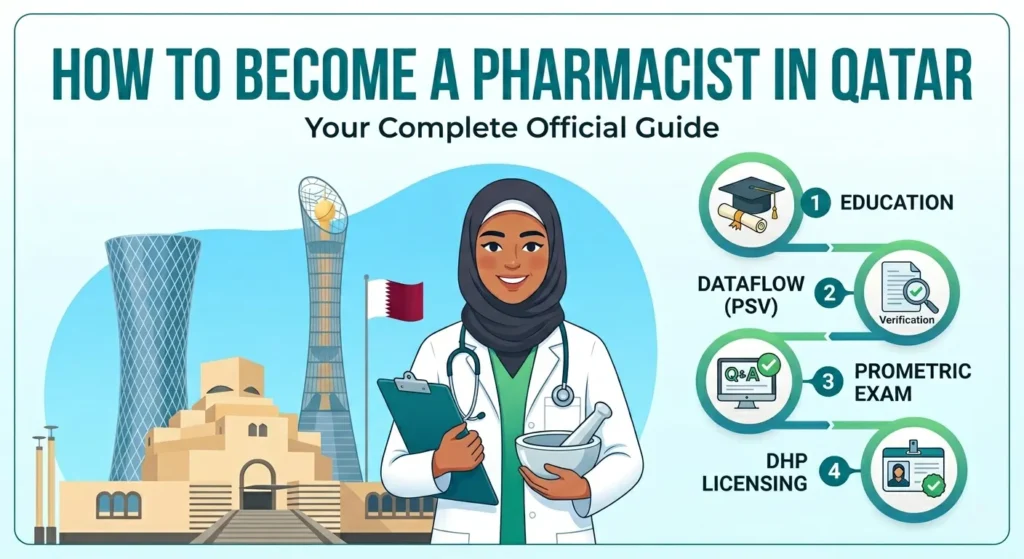
3. The Four-Stage Licensure Process
To obtain a “License to Practice,” every applicant must navigate through four distinct phases via the DHP Practitioner Portal.
Phase 1: Primary Source Verification (PSV)
Qatar mandates the verification of all credentials at the source. This is handled by The DataFlow Group or Quadrabay.
- What is verified: University degree, official transcripts, professional license from the home country, and employment certificates.
- Timeline: Usually 25 to 45 working days. You must receive a “Positive” report before you can finalize your registration.
Phase 2: DHP Qualifying Exam (Prometric)
Unless exempt, international pharmacists must pass the Qatar Pharmacist Prometric Exam.
- Exemptions: Qatari nationals and graduates from universities inside Qatar (public or private) are exempt from the qualifying exam.
- Format: 150 Multiple-Choice Questions (MCQs).
- Duration: 3.5 hours.
- Passing Score: 60%.
- Key Domains: Clinical Sciences (35%), Pharmaceutical Sciences (35%), Social/Administrative Sciences (20%), and Basic Biomedical Sciences (10%).
Phase 3: Registration and Evaluation
Once you have your PSV report and exam result, you apply for “Evaluation” through the DHP online portal.
- Create Account: Register as an “International Applicant.”
- Upload Documents: Submit all verified credentials for DHP review.
- Approval: If successful, you will receive an Eligibility Letter. This letter confirms you are qualified to work as a pharmacist in Qatar but is not yet a license to practice.
Phase 4: Final Licensing (Facility Linking)
A license is only issued once you have a job offer. Your employer (a licensed hospital, clinic, or community pharmacy) will link your profile to their facility.
- Final Step: DHP issues your License to Practice, which is typically valid for 1 to 2 years and linked to that specific employer.
4. Required Documentation Checklist
All documents must be high-resolution color scans. If they are not in English or Arabic, an official legal translation must be attached.
- Passport: Clear copy of the valid data page.
- Certificates: Final degree and official academic transcripts.
- Professional License: Valid registration from your home country or last country of practice.
- Certificate of Good Standing (CGS): Issued by your home country’s pharmacy council (must be less than 6 months old at the time of application).
- Work Experience: Official letters of experience on the facility’s letterhead, signed and stamped.
- Passport-sized Photo: Recent, with a white background.
5. Continuous Professional Development (CPD)
The DHP emphasizes lifelong learning. To renew your license, you must meet the National CPD Program requirements:
- Pharmacists must complete a specific number of CPD Credits (Category 1, 2, and 3) during each licensing cycle.
- Credits are earned through accredited workshops, seminars, and online courses approved by the Qatar MoPH.
6. Important Policies to Note
- Gap in Practice: If you have been away from the pharmacy profession for more than 2 years, you may be required to undergo a training period (supervised practice) or a re-evaluation exam.
- Retrospective Verification: In certain emergency cases, DHP may allow practitioners to start working while the PSV is in progress, but this is strictly governed by recent circulars and usually requires a “Certificate of Good Conduct.”
7. Summary Table: Fees and Validity
| Item | Details | Estimated Fee (QAR) |
| DataFlow (PSV) | Document Verification | 800 – 1,100 |
| Prometric Exam | Qualifying Test | 700 – 900 |
| DHP Evaluation | Profile Review | 200 |
| Annual License | Practice Permit | 600 – 800 |